Delta Council faces farm strain, broadband gaps, health care and ag security
by Lora Delhom
The Delta Council, which represents agricultural and business leadership across the region, convened Thursday, Dec. 4, for its 2025 mid-year meeting amid mounting economic pressure in agriculture, infrastructure challenges, and a keynote address from Mississippi State University President Dr. Mark E. Keenum.
 Delta Council Updates
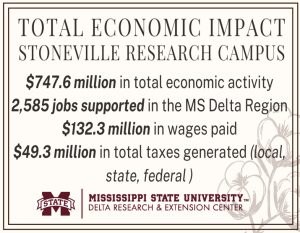
Leadership opened with the wonderful good news graphic from the research study, Economic Contributions and Impacts of the Stoneville Research Complex (FY2023).
Key Findings From the Economic Study
These figures reflect annual impact — the result of recurring research activity, agricultural innovation, federal and state operations, and private-sector demand generated by the eight entities that share the Stoneville campus.
Delta Council Leadership then gave a frank assessment of 2025: this has been one of the most difficult years for producers in roughly fifty years. The weak opening to 2025—marked by low commodity prices, high input costs and continued market decline—was compounded by transportation issues that strained margins and delivery throughout the year.
The council said that overall they are anxious to learn the next steps from Washington regarding the USDA/ARS area office, progress on water supply projects, and clarity on early childhood and K–12 educational policy. Strong support for higher education—particularly Delta State University and Mississippi Valley State University—was also noted as a regional priority.
Healthcare remains a major push, a major improvement and a major unresolved issue. For the past two legislative sessions (2024–2025), the Council has pushed for a Delta Regional Health Authority that would create a coordinated care network so Delta residents would not have to leave, or relocate, to receive medical treatment. The legislation failed in both sessions, and there is no bill planned for the upcoming year.
The meeting also included many memorials and retirements. Of special note, longtime Greenwood Commonwealth editor Tim Kalich was recognized on his retirement.
 C Spire Remarks
Meeting sponsor C Spire highlighted broadband expansion as essential infrastructure for the Delta. Chris Champion, the company’s vice president of government relations and a Leflore County native, said reliable rural broadband is “no longer a luxury but a lifeline,” adding that Delta progress depends on partnerships like those with the Delta Council. C Spire’s recent investments include more than $16 million in fiber expansion across central Mississippi, aimed at closing long-standing digital gaps affecting education, economic development, and healthcare.
Keynote Highlights: Dr. Mark E. Keenum
Before the keynote, the Council introduced Dr. Mark E. Keenum, president of Mississippi State University, noting his long career in agricultural policy, research, and public service. A former Under Secretary of Agriculture in the George W. Bush Administration, Keenum holds a Ph.D. in agricultural economics from Mississippi State University, where his early research focused on the catfish industry. He currently serves as chairman of the Foundation for Food and Agriculture Research and is a past chairman of the Board for International Food and Agricultural Development.
Dr. Keenum—who spent part of his childhood in Greenwood and Yazoo City—opened with reflections on returning to the Delta and a brief, self-deprecating story about being denied a parking spot on campus despite being university president. “I don’t care who you are,” he recalled being told. “You ain’t gonna park here without a permit.”
He traced his path from agricultural economist to federal policymaker, including his service as Under Secretary of Agriculture under Sen. Thad Cochran, and touched on his current national roles, including service on the College Football Playoff Board, where he supported expanding the field from four to twelve teams. “I wanted a Mississippi team in the playoff,” he said, drawing laughter from the room.
The Thad Cochran Lessons
Keenum described entering the Senate as a staffer in 1989 during the 1990 Farm Bill. Cochran’s guidance was straightforward:
“If it’s good for Mississippi and good for Mississippi agriculture, I’m going to be for it — and that’s what I got YOU for. To tell me what is good and what is bad for Mississippi and Mississippi ag.”
Keenum emphasized the role Delta Council played in shaping national agricultural policy, noting: “The voice of the Delta Council was heard around the country… farmers across our nation were helped by this organization.”
He also recalled Cochran’s humility, including a moment when a woman from DeSoto County told the senator, “I think you are an eloquent listener.”
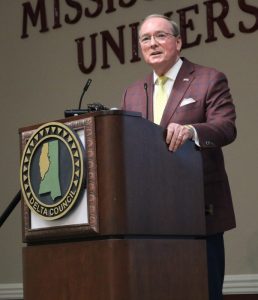
Dr. Mark E. Keenum, President of Mississippi State University
Faith, Farming, and Resilience
Keenum drew parallels between leadership and farming. Farmers face weather, markets, inflation, government policies, risk and uncertainty. “You have to be humble to be a farmer,” he said, adding that faith is essential to navigating difficult times. Mississippi State, he said, is committed to serving farmers and producers in every way possible.
Agriculture as National Security
Keenum stressed that the U.S. food supply is safe, affordable and too often taken for granted. “Food and farming is peace.” “Food security is ag security is national security.”
MSU Leadership in Agricultural Innovation
Keenum pointed to Mississippi State’s role in agricultural innovation, citing the Agricultural Autonomy Institute’s work in robotics, data science, and autonomous systems. He also highlighted the university’s high-performance computing assets, including the Atlas Supercomputer, a newly funded second system supported by USDA-ARS, and the university’s No. 4 national ranking in high-performance computing capacity.
He praised ARS Southeast Area Director Archie Tucker as “a tremendous leader” and shared remarks from USDA ARS Administrator June Park, who described the Stoneville–MSU partnership as a national model. Keenum also referenced the recent Starkville campus visit by U.S. Secretary of Agriculture Brooke Rollins, who toured the university’s research facilities and collaborations.
Leadership Advice and Closing Message
Keenum closed by recalling advice from a former college president: that leadership requires “the patience of Job,” “the courage of David,” “the wisdom of Solomon,” and “the stomach of a billy goat.” He connected those words to the lives of the farmers in front of him—the weather, the prices, the uncertainty, and the quiet grit it takes to keep showing up when the year has been harder than most. In a room full of people who carry those burdens every day, his tone shifted from policy to something closer to pastoral.
“Whatever challenges you face… no matter what… we will be there,” he said, reminding producers that their work anchors the Delta’s spirit as much as its economy. “You mean too much for the Delta, this region, this state, and this nation.”
And beneath all the hard news and hard truths, the people in that room shared one unspoken resolve: to protect what the Delta grows, preserve who we are, and keep the land—and the families who steward it—alive for the next generation.