🏛 Back to the heart of it: Eureka in the Delta
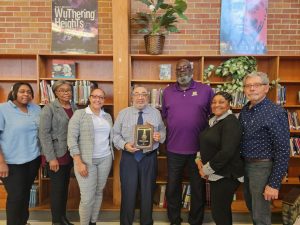
In February 2025, the Mississippi School Boards Association recognized Leland School District as a Lighthouse School Leader Torch Award district — a distinction that signals what’s possible.
Part III: How a rural Mississippi town is channeling Euclid — aligning schools, research and Main Street to power its future
In the TV series Eureka, a secret government town houses the country’s brightest minds. Growing up in Chicago’s south suburbs, I used to joke that we already had our own version — Batavia. Everyone knew it as “the Fermilab town,” a quiet place with glowing-cow rumors and more Ph.D.s than seemed possible. Fermilab’s arrival in the late 1960s put Batavia on the science map and made it a destination for scientists and their families.
When I moved to Leland last year, that memory came back. This little Delta town felt like it might hold that same hidden brilliance — a rural place quietly brimming with potential. I wasn’t far off: Washington County has more Ph.D.s per capita than many college towns, thanks to Stoneville’s 14 research entities and dozens of doctoral scientists.
So why isn’t Stoneville known that way here? Batavia’s story shows what happens when a community leans into its research identity: Fermilab transformed the town, sparked school partnerships and turned Batavia into a global research destination — the kind of place where schools, shops and community life were as vibrant as the research itself.
△ The Three-Pronged Vision (Yes, That’s 180°)
Rev. Jessie King, superintendent of Leland Public Schools, calls it a “three-pronged approach”: connect schools, Stoneville’s research hub and Main Street, so all three thrive together. Each angle must hold if the figure is to keep its shape — schools, Stoneville and Main Street working as a balanced whole.
🏫 Schools: The Talent Pipeline (60°)
Leland’s schools are proving what rural excellence can look like. In 2025, 100% of third graders passed both math and reading on the MAAP — a sign that Mississippi’s early literacy reforms have taken root even in small Delta hubs. The district earned a B overall, with Edna M. Scott Elementary scoring an A and Leland School Park (middle) earning a D.
Nancy Loome of The Parents’ Campaign notes that Mississippi’s historic progress raises expectations and increases the difficulty of future gains. King credits the B to teacher retention and curbing absenteeism: “We continuously studied the data. It is doable and achievable if there is buy-in from staff and administration.”
🔬 Research Hub: Stoneville’s Living Lab (120°)
Three miles away, Mississippi State University’s Delta Research and Extension Center and USDA’s Jamie Whitten Center employ dozens of Ph.D. scientists, making Stoneville one of the most intellectually dense rural research hubs in the nation. Their long-standing partnership — the Mississippi Model — ties research, economic development and public health together and is cited nationally as a model of rural innovation.
MSU and USDA already host Field Days and the world-class Gin School — ready-made platforms to connect students with real science. The next step is aligning K-12 pathways, so kids can see themselves in those careers: small student cohorts in research settings, lessons tied to live projects and quick-hire summer jobs, so teens can work alongside scientists during peak season.
🌆 Main Street: The Third Point (180°)
Third Street is coming back — murals restored, shops reopening, young entrepreneurs investing. To attract and keep teachers and scientists, Leland needs more quality housing and “third places” — coffee shops, bookshops and maker spaces — where educators, researchers and families can connect after hours.
⚖ Trust, Growth and Equity
Mississippi’s accountability model rewards growth among the lowest 25%, but those bonus points eventually flatten — a plateau, not a backslide.
“The focus now is on sustaining excellence, not just chasing points,” King said.
Numbers tell only part of the story. Batavia didn’t have to undo generations of inequity when Fermilab came to town. Leland does.
Segregation and disinvestment left deep scars, and any path forward must rebuild trust across race, class, ability and school lines.
The stakes are high: Brookings found that homes near high-scoring public schools sell for about 2.4 times more than those near low-scoring schools — and about one-third of school funding comes from local property taxes. Strong public schools stabilize neighborhoods, raise home values and fuel the tax base that keeps schools strong.
Leland is proving it can be done: a majority-Black district with a B rating and 100% third-grade reading and math proficiency — showing that high expectations, strong administration and teacher retention can close gaps.
🚀 A Blueprint for the Future
Mississippi’s “Mississippi Miracle” vaulted the state to the top in fourth-grade reading gains. Pair that with the Mississippi Model — Stoneville’s research consortium — and you have something no other rural region has replicated.
The next step: align schools, Stoneville and Main Street into a rural innovation pipeline.
🌱 The Leland Innovation Lab School Pilot
A public option blending homeschool flexibility with district support. Families guide learning with a Leland teacher of record and join weekly science labs, art blocks and therapies. Vendor-approved specialists could offer enrichment and dyslexia/ADHD supports and a hub bus would ensure rural access. Partnerships with Stoneville would connect students to Field Days, Gin School and hands-on research exposure — keeping them rooted here.
🌱 Gifted & 2E: Belonging Over Acceleration
Gifted and twice-exceptional students master grade-level work quickly — what they need is pace, depth and peers who think like they do. The Big Bang Theory never diagnoses Sheldon; we just watch him find friends who help him grow. Every “Sheldon” deserves that circle — a space where curiosity becomes projects and friendships.
Leland has the intellectual capital. The challenge is turning it into momentum. If schools, Stoneville and Main Street are the three angles of Leland’s triangle, the Innovation Lab School is the point of concurrency — where the medians meet and the figure finds balance.  A triangle’s strength lies in all its angles.
📲 Scan to Read the Full Plan
(QR code — links to The Leland Progress website)
🔗 Online You’ll Find:
📑 Full Plan & Parent FAQ
🧭 Innovation Lab Pilot Details
📊 Campus Scores & Data Lessons
💬 Comment