Back to the Heart of It: What Happens Next Part V: The Quiet Revolution Becomes a Community Promise
By Lora Delhom
On a clear, autumn-on-the-cusp-of-winter evening in Leland, backyard fire pits glow, and laughter drifts across yards like small, determined stars. Children carry artwork from their classrooms, neighbors linger along Third Street catching up, and storefronts spill warm light onto the sidewalk. Along the highway, rows of white cotton — Delta snow — lie after being sent to the gin, and, for the first time this season, it feels a lot like Christmas.
Across town, families wait with excitement for Christmas on Deer Creek — carols by the tree and the kind of fellowship that fills rooms lit by candles with songs and quiet togetherness.
In this golden light, the story of the year comes into focus: The quiet Leland revolution that builds each day is no longer hypothetical…or quiet. It’s happening — and it depends on all of us.
The Delta Has Always Known How to Protect Each Other
The Delta knows how to protect its own. This fall, as measles outbreaks surge in surrounding states, Mississippi — often dismissed by national observers and the Delta even more underestimated— posts some of the nation’s highest childhood MMR vaccination rates. It isn’t politics; it’s instinct. Here, you keep your neighbors safe. One simple truth anchors this place: people take care of each other.
That same instinct powers Leland’s renaissance. It isn’t a mural or a headline — it’s the small, quiet decisions people make every day to show up for their neighbors.
Together, these choices form our civic immune system — the quiet ways we feed one another, support our young people, and keep one more family rooted in this soil.
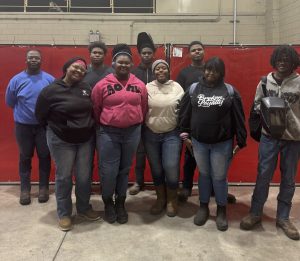
Welding cohort
On their own, each choice looks small. Together, they keep a rural town healthy, hopeful and learning.
Work-Based Learning: Where the Renaissance Becomes Real
This fall, ten Leland High School students enrolled in welding classes at the CAPPS Center through a continued partnership between Leland Public Schools and the Warren-Washington-Issaquena-Sharkey Community Action Agency (WWISCAA). The training leads to industry-recognized credentials and opens pathways to high-demand Delta careers. The program is funded through the Workforce Innovation and Opportunity Act with support from South Delta Planning and Development.
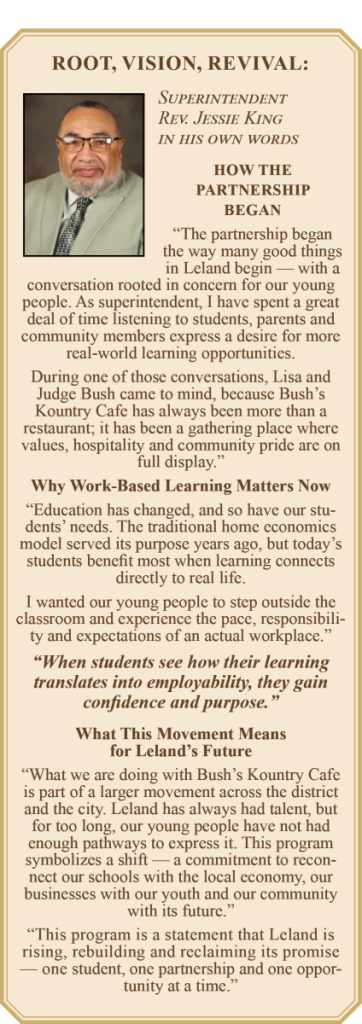
Leland Public School District Superintendent Rev. Jessie King calls the partnership “extremely beneficial to the students in Leland.” WWISCAA leadership notes that expanding opportunity for youth is central to their mission.
And then there is Bush’s Kountry Cafe, where teens learn reliability, knife skills and the rhythm of a working line — a living example of workforce development and generational leadership.
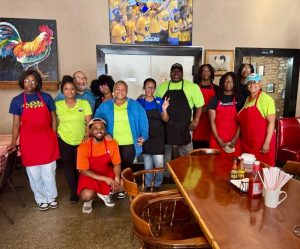
Bush’s Kountry Cafe and their cohort
Lisa Bush describes the moment this calling became clear:
**“When I didn’t win the recent mayoral race, God quickly reminded me of my true call to entrepreneurship. A fellow business owner said, ‘You don’t have to be the mayor to make an impact in our town.’ This past week, my husband and I hired several students from Leland High School’s work-based learning program. Whenever we reach out to the Vocational Center, Director Ebone Brownlee always comes through. We have a heart for service and a special love for young people. Helping our youth ‘learn and earn,’ while instilling in them the value of making Leland home — that’s the assignment God gave us.”**
Superintendent Rev. Jessie King says the program reflects exactly what Leland’s young people deserve — real skills, real responsibility, and real pathways.
“I am extremely proud of the students at Leland High School who are receiving a more comprehensive experience than the home economics program of my time. Work-based learning is being effectively integrated through partnerships like the one with Lisa Michelle Bush and Judge Bush, providing valuable training in food preparation, dining operations, customer engagement, entrepreneurial skills, ServSafe practices and more.”
In King’s words: “Let’s rejuvenate the Delta. I am determined like never before to give it my all — and I hope you are too.”
But to him, this work is part of something even larger — a community revival:
“We are witnessing a community revival. It is refreshing and a joy to see young, middle-aged and elderly residents rally around a common cause — to improve the place we grew up in. We must educate, stand in the gap and teach our children how to work together kindly and serve generously. We must all activate and participate. This is not a one-sided problem. It is a humanitarian problem — an onslaught against our community. Where there is unity, there is strength, and much can be done.”
I have watched the weight of these past few months on Rev. Jessie King — superintendent, pastor, son of this soil — and I see what he carries for all of us. His message is pastoral, communal, ancestral. His vision for Leland’s future runs deeper than a program — it is a restoration of dignity, purpose and community.
 The Year Leland Discovers Its Own Potential
Month by month, the arc of the year reveals something remarkable:
August shows us the data — Washington County is one of the most intellectually dense rural regions in the country. September reveals what we knew to be true about safety, race and belonging here before the tragedy that would test us. October offers a shared blueprint linking our schools, Stoneville and Main Street. November asks us to steady ourselves after heartbreak — proof that renaissance is not only momentum; it is resilience.
The Hardest Part of the Story
And woven into all of this is a harder truth — one we cannot ignore if we hope to heal it.
In the hours before the tragedy, fear moved faster than facts. Some Lelanders, trying to protect “their own,” showed up armed, unsure who to trust and uncertain whether help would come. It was misguided, yes — but it rose from a deep instinct, the same instinct that has kept families alive through generations of storms, floods and hardship.
It was also a sign of a deeper fracture: a crack in trust between residents and the institutions meant to protect them. But cracks can be mended.
Already, small signs of repair are appearing — moments like the students-versus-staff basketball game, where officers, firefighters, educators and kids shared the same court and the same laughter. Moments where the FBI arrests bring accountability and the possibility of rebuilding something sturdier.
These are not quick fixes. But they are steps. They are gold slowly being poured into the break.
December asks the hardest question of all: Will we participate?
A renaissance doesn’t survive on excitement. It doesn’t survive on “good enough” or “that’s just how it is” or “someone else will do it.”
A renaissance survives on follow-through.
It survives on the grit and gumption of the people who came before us — the forefathers and foremothers who worked this land through floods, storms, droughts and uncertainty.
And this moment, right now, is our flood.
No water rising. No levee breaking. But pressure, loss, change and hope all converging at once.
So what will we do? What will we rebuild? Where will we stand? And what future will we choose to shape with our own hands?
As Rev. King often says: “A community’s future is shaped by what its people decide to invest in — daily.”
And when a community survives its flood — literal or not — what matters most is how it repairs, how it rises, and how it chooses to shine.
The Golden Glow
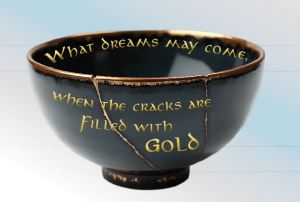
In November, we held up a kintsugi bowl and talked about what it means to mend something with gold. A bowl doesn’t hide its fractures; it honors them. It becomes stronger because of them — more capable of holding what comes next.
Now, in December, the town stands inside its own version of that kintsugi shine — a golden glow rising from porch lights, fire pits, church halls and windows along Third Street. The light we see is not accidental. It comes from the same instinct that fills a crack with gold: the willingness to show up for each other, even when the year stretches us thin.
Leland’s renaissance isn’t flawless. It doesn’t need to be. What matters is how we repair ourselves — with help, with hope, with neighborly instinct, with the grit and gumption that define this place.
Every repaired place shines. Every repaired community shines brighter.
And what shines here now — this quiet revolution, this steady glow — is ours to carry forward.