
ARRF volunteers and donations wanted
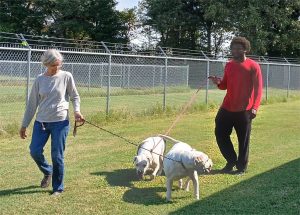 With thirty-four dogs housed in two shelter buildings and five in foster homes, Animal Relief and Rescue Fellowship (ARRF) in Leland is in desperate need of volunteers, donations, fosters and adopters.
“These dogs are here through no fault of their own” said Ann Fratesi, the shelter manager. “It is people who have failed them. It is the responsibility of the humans to see that the dogs are cared for.”
The dogs that are in the shelter are strays that have been rescued around the area. Because of space concerns, the shelter does not take in surrenders. “We just don’t have the room,” Fratesi said.
The main brick building was erected just three years ago, complete with indoor and outdoor runs for the dogs, and was quickly filled up. Now, both the “new” shelter and one of the old shelter buildings are full to overcapacity. Fratesi said she found out about the Leland Animal Shelter in 1998. “I had lived here for years and didn’t even know there was a shelter here,” she said. “And it was horrible.”
Fratesi said she couldn’t imagine what feeding time was like. She never actually saw feeding time, but imagined it was horrendous.
By herself, with no resources, no knowledge of how to help and no rescues to take dogs, she still knew she had to do something for helpless creatures. It was the beginning of her shelter work.
“I have been an animal lover all my life,” Fratesi said. “I started bringing home stray dogs and cats when I was old enough to realize that all animals didn’t have loving homes. I tell people that this is a passion that God gave me, because if I were to choose one, it would be easier on my heart, my head, my body and my pocketbook.” Her first order of business was to change the method of the “euthanasia” being done at the shelter. Now, if necessary, dogs are put down in a much more humane manner. The shelter has gone from having a ninety-nine percent kill rate to having a ninety-seven percent adoption rate. “Over the years, we have placed thousands of Delta dogs into loving forever homes.”
Fratesi has been involved with the shelter since 1998, first in the two old buildings, then in the new, brick building. The new brick building, which opened three years ago, offers the dogs inside and outside runs and more room to move around. With the help of ARRF, Fratesi has changed the old dog pound with just indoor runs into a better operation with not only the better runs, but multiple large play yards and adoptions all over the country. The only dogs that get euthanized are those that are too sick to save or too vicious to safely and responsibly place in a home. “In twenty-six years, I can count on one hand the number of vicious dogs we have had,” she said. “And those were the fault of the human who owned them. They were trained to be vicious.”
“With a safe location in place, I realized that there was even more to do,” Fratesi said. “I contacted The Champion Farm for help with behavioral training for our shelter dogs.” They have sent five of their troublemaker dogs to Champion’s board and training program. All of those dogs have been adopted, and Fratesi says they are now living their best life in loving forever homes. “We have one dog at the training program right now,” Fratesi said. “It costs us $700 a week for the training, so we are always looking for donations for help pay for the training.”
There are currently five dogs in foster homes, but Fratesi said they could always use more fur-baby foster parents. “While the dog is in a foster, ARRF is responsible for everything,” she explained. “We pay for vet bills, food, everything.” And if the foster doesn’t work out, ARRF will pick up the dog as soon as possible, with no judgement. “We pick the animal up right away, no problem,” she said. ARRF has had some luck with adopting out its animals, but, again, more people wanting to adopt would always be a good thing.
“Many of our animals go up north to rescues, then are adopted,” Fratesi said. “We just don’t have enough people locally who want to adopt.”
Sending dogs to other areas has been a blessing, Fratesi said. “We have placed dogs in thirty-eight states,” she said. “Typically, however, they go to the northeastern states.”
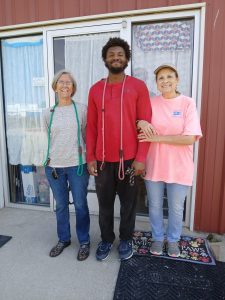 The City pays someone to clean the shelter every day. There are also five regular workers at the shelter between the ages of 65 and 73.
“It is getting to where we can’t do a lot of things,” Fratesi said. “It is kind of making me panic some. I am worried that there won’t be someone to take over when I can’t do it anymore.” Fratesi said the work hasn’t been easy, but it has been very rewarding. Finding loving homes for the dogs that might otherwise be put down is a heartwarming experience for her and others at the shelter.
“Dogs are so loving,” she explained. “They don’t care how much money you have, what you look like, what you are wearing. They just want you to love them, and they will give you unconditional love in return.” In addition to the regular staff, the shelter currently has five volunteers, including Lisa Sabbatini, with the Delta Health Alliance; Donna Crook and Brenda Stone, both retired from the Washington County Sheriff’s Department; Nathaniel Williams, a prosecuting attorney in the Delta area; and Carol Moss, with Twin County Electric.
More volunteers are needed for a variety of tasks, including playing with the dogs in their play yard, taking pictures of the dogs, transporting dogs to the veterinarian or just spending time with them. For those who might want to volunteer, but who don’t necessarily want to deal directly with the dogs, there is also a wide variety of things to do. “We need someone to wash towels and blankets constantly,” Fratesi said. “We need help working the flower beds, cleaning the office, sorting supplies, lots of things.” If someone is interested in not volunteering, but trying to help, the shelter also accepts donations of money, dog toys, treats, food, training pads, blankets and any other dog items.
Fratesi says her dreams for the future are to raise enough money to add more space onto the brick shelter, so the old buildings can be closed forever; to have more volunteers to help with the many needs and those of the dogs; to have more foster homes to keep the dogs/puppies for two weeks before adoption; and to find people who might not be able to come to the shelter, but who would like to elect a dog to sponsor.
For more information about adopting a dog, volunteering or donating to the shelter, interested individuals can contact Fratesi at 662-347-5573. She says if the call goes to voicemail, leave a message, and she will call back as soon as possible.
“These pups need help, and we welcome the community to join us to care for them.”



Wonderful story. Very impressed with the details of Ann’s work.