MDCC’s Greenville Higher Education Center Receives $50,000 Delta Compass Grant for CTE Programs
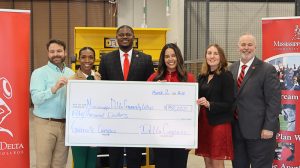
President and CEO of Delta Compass, Justin Burch (left), awards MDCC with a check for $50,000. Standing to his right (left to right) are Dr. Temika Simmons (Director of the Greenville Center), MDCC President Dr. Steven Jones, Dr. Valarie Morgan (Vice President of Instruction and Accreditation/Provost), Allison Folk (Dean of Career-Technical and Adult Education) and Douglas Freeze (Vice President of Workforce and Economic Development).
Mississippi Delta Community College’s (MDCC) Greenville Higher Education Center (GHEC) has been awarded a $50,000 grant from Delta Compass to support equipment purchases and marketing for career-technical programs at the Greenville campus. The funds will directly benefit students in high-demand vocational fields, including new program offerings in Industrial Electricity and HVAC.
Delta Compass, a Greenville-based nonprofit, partnered with MDCC through a grant agreement signed earlier this year. The one-time upfront investment will furnish vocational buildings at GHEC with the tools, machinery, and equipment students need to train on industry-ready technology. Additionally, 5 percent of the total budget will support marketing and promotional materials for the Greenville campus. The project timeline extends through May 30, 2027.
“Delta Compass is proud to support Mississippi Delta Community College with their new facility on the Greenville campus,” said Justin Burch, President and CEO of Delta Compass. “Aligning education with local employers is essential to building the skilled pipeline of talent needed for local industry and further makes quick transitions for student learners looking to bridge their careers.”
“This Delta Compass grant is a tremendous investment in workforce development for Greenville and the surrounding Delta region,” said Allison Folk, Dean of Career-Technical and Adult Education. “These funds will allow us to purchase industry-grade equipment and expand our outreach efforts as we launch Industrial Electricity and HVAC in our new Greenville CTE facility. We are building programs that directly respond to employer demand and create clear, high-wage career pathways for our students.”
The Greenville Higher Education Center offers multiple career-technical programs designed to prepare students for immediate employment, including Culinary Arts Technology, Cybersecurity Technology, Heating Ventilation Air Conditioning and Refrigeration Technology, and Industrial Electricity Technology. Each program provides accelerated pathways to industry credentials and associate degrees, with graduates entering fields offering competitive salaries and strong job growth.
“We are deeply grateful to the Washington County Economic Alliance for this generous $50,000 investment in the Greenville Higher Education Center,” said Dr. Temika Simmons, Director of the Greenville Center. “This award is more than funding — it is a vote of confidence in the growth and expansion we’ve experienced on our Greenville campus over the past two years. As enrollment continues to rise and new workforce programs launch, this support allows us to accelerate opportunity for students and strengthen our impact across Washington County. Partnerships like this demonstrate what is possible when education and economic development move forward together.”
As part of the grant agreement, MDCC will share updates with Delta Compass along the way. These updates will document how many students are enrolling and completing vocational programs, where they’re finding jobs, and how the funds are being leveraged for maximum impact. The final report will also include personal stories from students and a college narrative reflecting on what the grant made possible.
“Receiving the Delta Compass grant is an incredible affirmation of the transformative work happening at the Greenville Higher Education Center,” said Dr. Valarie Morgan, Vice President of Instruction and Accreditation/Provost. “This investment strengthens our ability to expand high-quality career and technical education for the Washington County community. We are grateful for partners like the Washington County Economic Alliance who believe in our mission and who help us create pathways that change students’ lives and support the region’s workforce needs.”