
Back to the heart of it: How a rural Mississippi town became an intellectual beacon
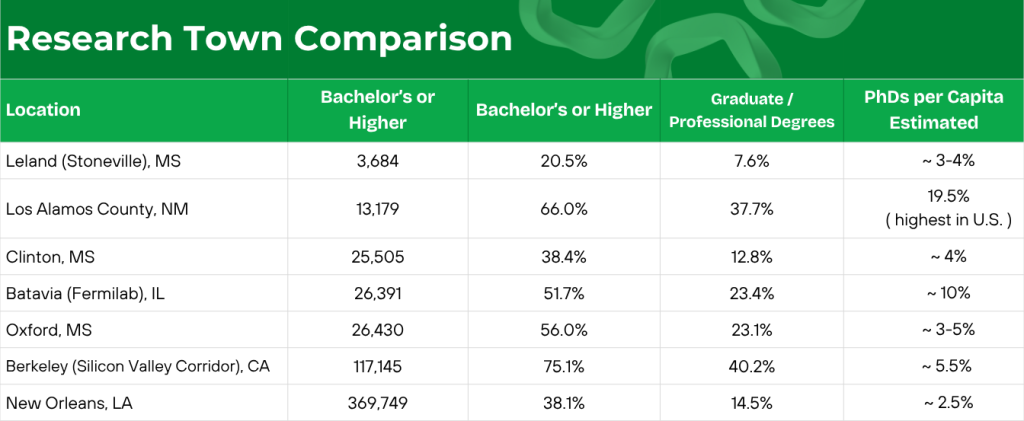
Data sources: U.S. Census Bureau (2023 American Community Survey 5-Year Estimates); National Science Foundation; local estimates based on institutional employment (Mississippi State University DREC, USDA ARS, Tulane University, Fermilab, UC Berkeley). Ph.D. per capita rates are approximations drawn from public workforce data, academic density estimates and regional research concentration.
By Lora Delhom
Part I: The stat that started it
There are more Ph.D.s per capita in Washington County, Mississippi, than in many college towns across America.
In a place better known for catfish ponds than college lectures, a quiet revolution has taken root. I came expecting sweet tea and front porches not casual chats about soil pH and nitrogen trials while cicadas hummed and we rocked gently on my neighbor’s Victorian veranda overlooking Deer Creek.
That wasn’t on my midlife bingo card when I left New Orleans but here we are: sipping humidity, swatting mosquitoes and swapping reading lists.
Faded Delta streets conceal a concentration of advanced degrees that rivals towns like Oxford. At the heart of that story inside Washington County is Leland, a town that’s both a microcosm of America’s rural past and a blueprint for its intellectual future.
The Stat and Its Significance
According to the U.S. Census Bureau’s 2023 five-year estimate, 20.5% of adults in Washington County (home to Leland and Stoneville ) hold a bachelor’s degree or higher, slightly above the 12–18% range typical across the Mississippi Delta. Still, the county lags behind the statewide average of 25.5% and the national rate of 35.7%, underscoring the region’s untapped intellectual capital.
Advanced degrees tell an even more compelling story. Washington County’s 7.6% advanced-degree rate which includes master’s, professional and doctoral degrees is notably higher than the estimated 5% or less typical in rural U.S. counties. It falls within the 8–12% range seen in rural areas anchored by major research institutions and is more than double the 3.3% statewide rate for professional and doctoral degrees in Mississippi, according to U.S. Census Bureau data reported by Statistical Atlas 2024.
Though older data suggested only 1% held doctorates, that figure fails to reflect Stoneville’s unique concentration of Ph.D.-level professionals. At Mississippi State University’s Delta Research and Extension Center (DREC), all 22 research faculty hold Ph.D.s. At the nearby USDA Jamie Whitten Center, staffing still includes dozens of Ph.D. scientists, postdocs and advanced-degree staff. The Delta Health Alliance quietly ranks third nationwide among nonprofit health organizations for Ph.D.-level researchers.
Stoneville is home to 14 research-focused entities including those big 3 above making it one of the most intellectually dense rural campuses in the country.
Even after recent federal work force reductions, dozens of doctoral-level professionals continue to live and work in a city of just 3,684. That puts the doctoral concentration currently around 3 – 4%, still positioning Leland and Stoneville among the most educationally advanced rural research hubs in the nation.
“These aren’t just oddball stats,” said one local educator. “They’re clues.”
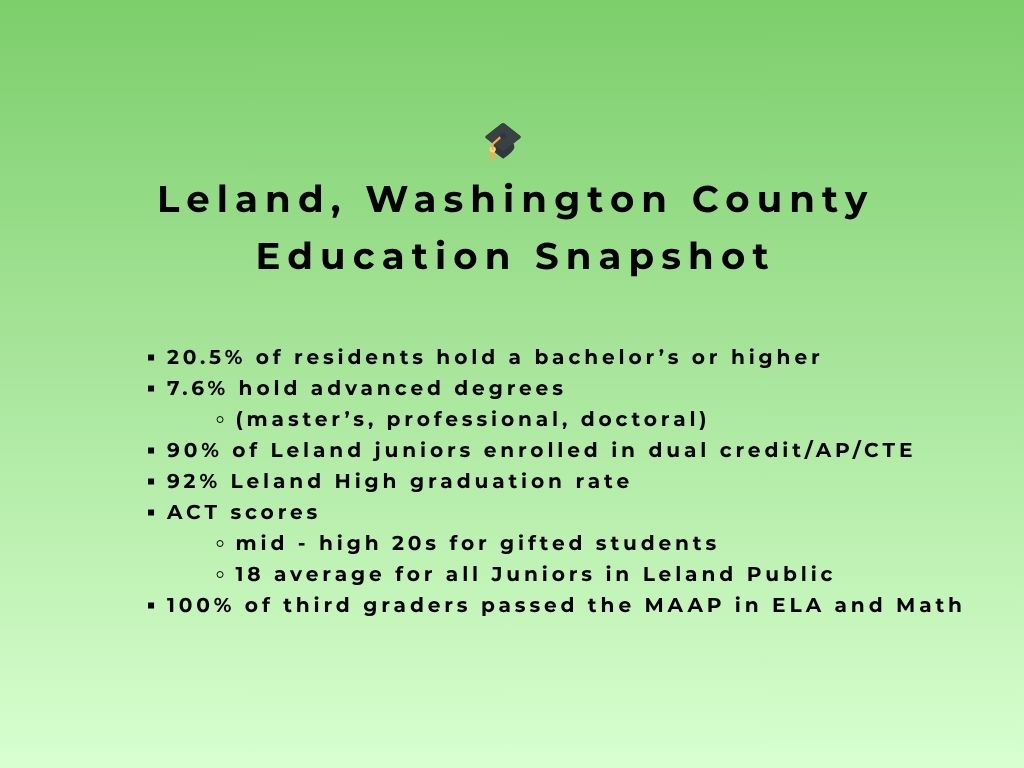
Sources: U.S. Census Bureau American Community Survey (2023), Mississippi Department of Education MAAP summary (2024), Mississippi Succeeds Report Card (2023), U.S. News & World Report (2024), local interviews (July 2025). Data reflects state- and district-level reporting.
Educational Anchors of Excellence
Washington County’s intellectual backbone is no accident. It’s the result of decades of investment in research, education and regional partnerships.
Delta Council, an economic development body based in Stoneville, awards scholarships across 19 counties and prioritizes education as a central pillar of regional revitalization (Delta Council, 2024).
Delta Health Alliance, headquartered in Stoneville, operates over 30 programs in healthcare, education and early childhood development. Its efforts include expanding access to medical home clinics, telehealth, electronic health records and Head Start programs, all grounded in data-driven and community-participatory research models (Delta Health Alliance, 2024).
The Delta Research and Extension Center (DREC), established by Mississippi State University in 1904, has grown from a cotton and soil-focused lab into a multidisciplinary hub for agricultural innovation, irrigation science and sustainability (Mississippi State University DREC, 2024).
USDA’s Jamie Whitten Delta States Research Center, also based in Stoneville since the 1950s, is one of the largest Agricultural Research Service (ARS) facilities in the Southeast. Its scientists lead national research in crop genetics, cotton ginning, insect management, aquaculture, soil health, water conservation and pollinator support (USDA ARS, 2024).
Delta State University in nearby Cleveland supports regional educators through its College of Education and the Delta Center for Culture & Learning, which administers NEH-funded heritage programs (Delta State University, 2024).
Mississippi Valley State University (MVSU), a historically Black university founded in 1950, continues to train rural educators and policy leaders, with strong graduate education advocacy (MVSU, 2024).
A Public School System on the Rise
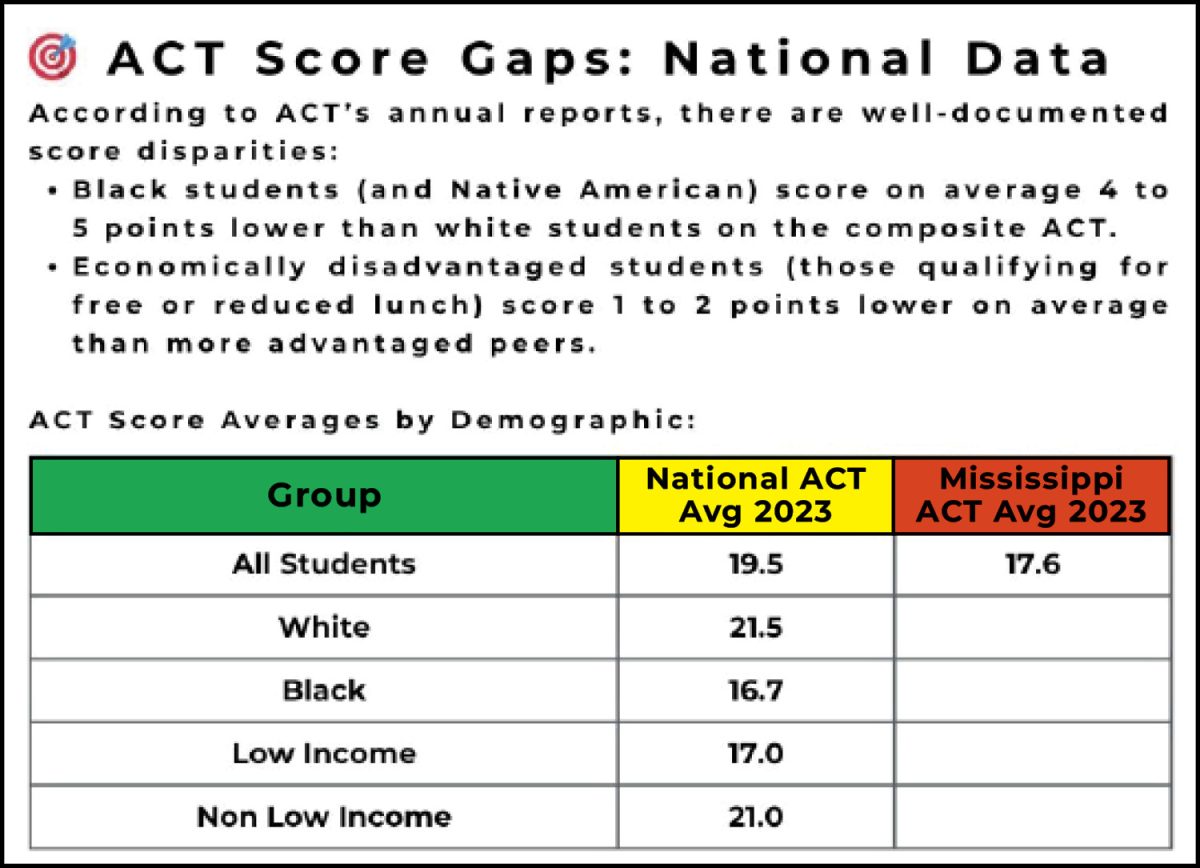
Sources: U.S. Census Bureau American Community Survey (2023), Mississippi Department of Education MAAP summary (2024), Mississippi Succeeds Report Card (2023), U.S. News & World Report (2024), local interviews (July 2025). Data reflects state- and district-level reporting.
Within Leland’s own city limits, the public school district is quietly making its mark.
The Leland Public School District emphasizes AP and dual credit programs, supported by a strong culture of professional development. Its graduation rate reached 92% in 2024, surpassing the state average of 89.4% according to U.S. News & World Report, 2024 and Mississippi Department of Education, 2024.
Mississippi Delta Community College (MDCC) partners closely with Leland High School on dual credit offerings. About 80% of MDCC’s dual credit students come from Leland, with approximately 90% of Leland juniors participating in dual credit, AP or CTE programs (Interview with Superintendent Rev. Jessie King, July 2025). This is a striking indicator of ambition and opportunity. By contrast, only 34% of Mississippi students and just 27% of Black students statewide take at least one dual or concurrent enrollment course according to the Mississippi Department of Education, 2024. Early indicators are strong as well: 100% of Leland third graders passed the MAAP in both English Language Arts and Math last year.
“This goes back to the three E’s — empowering, embracing, and excelling,” said Susie Williams, the district’s curriculum director.
Gifted students are identified early and supported through weekly, project-based enrichment. Advanced learners at Leland High score in the mid to high 20s on the ACT, far above national averages for both low-income and minority students. In fact, nationally, Black students score 4 to 5 points lower than their white peers on the ACT and economically disadvantaged students lag by 1 to 2 points.
In that context, Leland’s academic trajectory isn’t just impressive. It’s exceptional.
Leland and Stoneville Washington County prove that rural communities can be intellectual strongholds, not educational deserts.




Congratulations
Leland/Washington County have some of the most kind-hearted, caring and compassionate people that you will ever be honored to call your friends and neighbors!