
Bishop Wells at St. John’s: Four women, one Gospel road
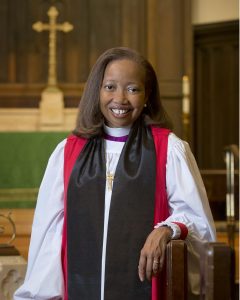
Dr. Dorothy Sanders Wells
Thank you, Bishop Wells, for your prayers and steady presence with us. She came to St. John’s bearing a story in wood—her bishop’s staff (crosier)—and invited us to see the Gospel through the hands and footsteps of four women.
The crosier itself is a sermon. Carved by Mr. Williams, a Gullah artist from South Carolina, the staff holds the hand of the hemorrhaging woman (Mark 5) reaching out—twelve years unwell, twelve years set apart as “unclean,” and still she dares to touch the hem of Jesus’ garment.
“Her faith was that great,” Bishop Wells said. Jesus feels the touch, names it, and then names her clean so the whole community can know what grace has already done. Healing isn’t just private; it’s restoration to one another.
From there, the bishop walked us to a blue well in Samaria (John 4). Jesus crosses a boundary—gender, ethnicity, history—to ask a woman for water. Their conversation becomes living water for an entire town.
“She runs to tell her people,” Bishop Wells reminded us, because when you’ve been truly seen, you can’t help but witness.
Next came the Canaanite (Syrophoenician) woman (Matthew 15). At first, the answer sounds like a hard no: “It isn’t right to take the children’s bread and toss it to the dogs.” But she refuses despair. “Even the dogs eat the crumbs that fall from the master’s table,” she replies. Just give me the crumbs—and her daughter is healed.
Faith, Bishop Wells noted, can look like holy insistence: staying at the table until mercy widens.
On the altar, she pointed to bread on the table—a simple loaf that meets us where we are, like Matthew’s tax booth or Martha’s kitchen work. The Gospel isn’t abstract; it’s shared bread and open boundaries.
“Healing isn’t just private; it’s restoration to one another.”
Finally, the bishop traced a road that runs off the cross and into the garden—Mary Magdalene’s road. In all four Gospels, Mary is the common witness who meets the risen Christ and is sent: “Go and tell my brothers.” Bishop Wells called her the first preacher of the Resurrection, a woman is entrusted to carry life back to a world that had only just learned the word empty.
With the windows bright behind her, Bishop Wells held the crosier and invited us to see our own hands in that carved hand, our own feet on that road: to reach for healing, to cross the lines that keep us apart, to stay at the table, and to walk that road together.
As she blessed us, the charge was simple and costly:
• Name the healed clean—so restoration becomes communal, not just clinical.
• Ask for water and share it—receive before you preach.
• Stay for the crumbs—mercy multiplies once it starts.
• Walk Mary’s road—speak resurrection into ordinary days.
Bishop, thank you for your courage and craft—for bringing a shepherd’s staff that tells the story with its very grain. May the hand on your crosier teach our hands to reach, welcome and bless—until everyone knows they belong at the table.
The Rt. Rev. Dr. Dorothy Sanders Wells was ordained and consecrated as the 11th bishop of the Episcopal Diocese of Mississippi on July 20, 2024, at St. Andrew’s Episcopal School in Ridgeland and was seated at St. Andrew’s Cathedral in Jackson the next day. She was elected February 3, 2024, at the 197th Annual Council and succeeds the Rt. Rev. Brian R. Seage.
A native of Mobile, Alabama, Bishop Wells earned a B.A. from Rhodes College and a J.D. from the University of Memphis, practicing employee benefits law for eighteen years before answering a call to ordained ministry. She received her M.Div. from Memphis Theological Seminary and D.Min. from Emory University’s Candler School of Theology.
Before coming to Mississippi in May 2024, she served as rector of St. George’s Episcopal Church in Germantown, Tennessee.
An award-winning essayist and longtime advocate for community dialogue, racial healing, and equity, her writings can be found on Muck Rack. Bishop Wells and her husband, Herb, have two daughters.




Wonderful article! We in the Diocese love our Bishop!