Farmers view automated polypipe puncher at NCAAR field day
By Lora Delhom
 A prototype automated polypipe hole-punching system turned heads during the National Center for Alluvial Aquifer Research’s Irrigation Field Day on June 12 in Leland.
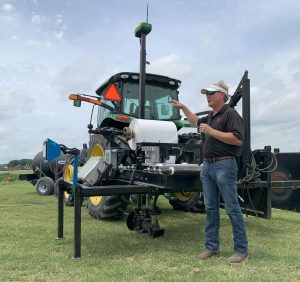
Nearly sixty farmers, researchers and ag professionals gathered to see the machine in action. Designed by Wes Lowe, assistant professor of agricultural and biological engineering and a scientist with the Mississippi Agricultural and Forestry Experiment Station, the system punches precise, elliptical holes in the field — rather than in the shop — marking a departure from traditional practice.
The automated system is a collaboration between Lowe and other Stoneville scientists. It’s still in development, but has the potential to significantly reduce labor and water costs for growers.
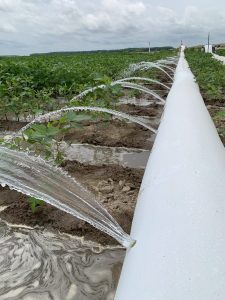
“When complete, the new technology could replace the labor-intensive job of manually puncturing the polypipe, which often causes frayed and irregular-shaped holes,” Drew Gholson said. He estimates water savings of 25 to 50 percent — a major gain in a region where about 70 percent of farmland is irrigated, and 83 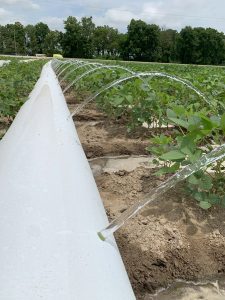 percent of that uses furrow irrigation with polypipe.
Attendees viewed a side-by-side demonstration comparing standard round holes punched manually with elliptical holes created by the new system. The difference was clear.
“The elliptical holes allowed for greater precision in how much water was applied to each row,” one attendee said. “It’s easy to see how this could help both efficiency and consistency.”
The prototype, displayed raised on tractor forks, drew close inspection and discussion.
In addition to the polypipe demonstration, the event included updates on irrigation scheduling, wide-row irrigation, soil health, water quality and cover crops. A vendor expo showcased tools for improving water management, and guests enjoyed a classic Delta luncheon following the sessions.