
Fields of struggle, seeds of hope: Delta farmers brace for 2025
Mississippi’s row crop producers are facing one of their bleakest financial years in decades, with new state and regional analyses showing losses across every major commodity. Economists and producers say the downturn carries echoes of past crises, from the 1980s farm collapse to the hollowing out of Chicago’s manufacturing base, when structural shifts wiped out livelihoods and reshaped communities.
Much like the Rust Belt’s decline, today’s farm crisis is not just about profit margins but about the survival of towns whose economies revolve around a single industry. Economists warn the current downturn is not only a Delta or Mississippi Valley problem, but an early indicator for the Midwest and the nation. Delta farmers have already seen the collapse of their traditional price advantage near the Mississippi River, with soybean basis levels dropping 30 to 40 cents below normal even before harvest. If those losses spread north as the Midwest brings in its crop, producers across the country could face a similar or deeper squeeze on prices and demand.
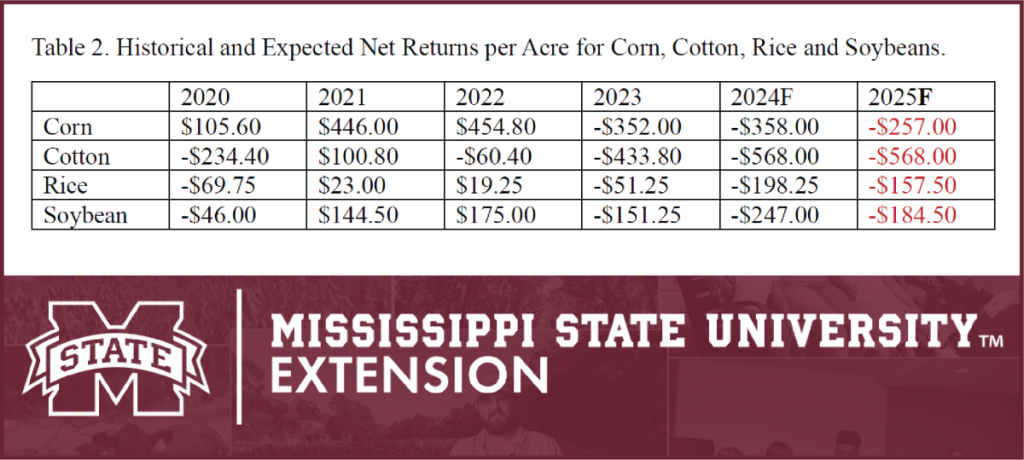
The 2025 Mississippi Row Crop Situation Report from Mississippi State University Extension shows corn, cotton, rice and soybeans are all projected to lose money this year. Depending on crop mix, a 3,000-acre Delta farm could post losses ranging from about $500,000 to nearly $1 million. Cotton faces the steepest decline, with losses of nearly $500 per acre, while soybeans, usually the most forgiving crop, are still expected to lose about $150 an acre.
Economists call cotton a “canary crop,” because it is highly sensitive to global trade cycles and oversupply. Prices fell below 10 cents a pound in the Depression, collapsed to 47 cents in the 1980s and dropped to 42 cents in the early 2000s as China’s entry into the World Trade
Organization reshaped markets. Today, cotton averages about 62 cents, still weak enough to saddle Delta producers with losses. Analysts say such downturns often coincide with broader economic shocks, much as copper reflects global industrial demand.
At the Delta Council August farm update, agricultural economist Steve Martin described the outlook as “the toughest it’s been in at least twenty-five years.”
Farmers testified that even bumper yields can no longer guarantee a profit.
“You can make a big crop and still at best break even,” Washington County producer Rob Baker said.
The squeeze reflects both local setbacks and global headwinds. Heavy rains followed by drought hurt yields across the Delta, while international markets remain glutted with grain. Brazil has added cropland the size of Nebraska annually, doubling its soybean output in a decade, with Chinese financing ports and railroads to absorb exports. Those expansions helped push down world prices.
At the same farm update meeting, both a banker and an economist warned that the only thing keeping many producers’ balance sheets in the black is high land values. If those prices fall as they did in the 1980s, when farmland lost more than half its value, the crisis could shift from compounding income losses to outright insolvency. More than 300,000 farms defaulted in that decade, a wave of foreclosures historians call a lost generation.
“This is not just a farm problem,” said Delta banker Bradley Lunsford. “It affects landowners, gins, elevators, equipment dealers — whole towns.”
Extension officials point to small bright spots. Fuel and fertilizer prices dipped modestly in early 2025, even if offset by record-high fixed costs. Livestock markets remain strong nationally, providing balance to the broader farm economy. Farmers also received a limited ad hoc payment this spring and are signing up for disaster aid on past crops. New federal legislation, the OBBBA, is scheduled to deliver additional program payments in 2026, which Extension economists call “a win for row crop producers,” even if delayed.
Producers are also banking on the political lessons of last year. Mississippi growers sounded the alarm in Washington months before harvest, but it was not until the Midwest began bringing in its crop that lawmakers began to act.
“We got traction once the Midwest started realizing there was nothing there from the marketing side,” Delta Council member Clint Dunn said.
Farmers, producers, economists and bankers across the Delta are holding out hope the same shift in national awareness could spur policy action again this fall. For now, they say they are left waiting for either a rebound in global demand or a policy breakthrough.
“For the last one hundred years, U.S. agriculture has produced the safest, most consistent and cheapest food supply to the American public,” Martin said. “In my lifetime, this is the first time it’s been in real peril.”





Those millions of pounds of rice would sure make a lot of Saki. Don’t understand the State, Federal Government or Insurance companies not funding this as an option to letting crops rot.