Helping Leland Heal: When Calm Is the Cure
by Lora Delhom
Leland counselors say compassion and consistency are key to family recovery after trauma.
As families across Leland continue processing recent violence and law enforcement activity, local counselors say the road to recovery begins with consistency, compassion and connection—not perfection.
Behavioral health professionals from Leland Medical Clinic and Delta Health Alliance are working together to help families recognize trauma responses early, avoid re-triggering experiences, and take practical steps toward healing.
 Calming the Fight-or-Flight Response
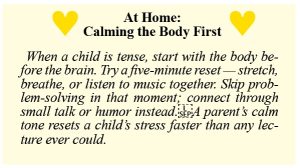
When fear spikes, even everyday routines—like walking into school or saying goodbye to a parent—can feel overwhelming. Predictable routines and trusted relationships help lower anxiety and reduce “fight-or-flight” reactions.
Behavioral therapist Destiny Bradley, who works with children and families at Leland Medical Clinic, said the fastest way to calm fear is to address the body before the mind.
“Encourage ‘body-first calm’ moments before homework or house chores – such as gentle stretching, listening to music for five to ten minutes, or slow deep breathing to decrease muscle tension and lower stress,” she said. “Avoid problem-solving in that moment, as this can increase emotional and/or physical symptoms. Instead, connect through positive small talk. Most importantly, remain calm. A calm adult helps reset a child’s nervous system faster than logic or discipline.”
She added that predictability—trusted routines, calm spaces and consistent check-ins—helps families and children feel secure.
When Parents Must Leave
Small rituals can help children feel safe when parents have to be away. Bradley said that “using short and sweet goodbyes before each departure can set in consistency and comfort for kids.”
For example, sayings such as ‘see you later alligator’ or a hug can bring comfort to a child as the parent leaves,” she said. “During the time while a parent is away, sticking to routines and allowing the child to keep something of connection, such as a picture or toy, can help the child remain calm and feel safe. When returning, acknowledging the child’s feelings and ability to get through the departure time can build resilience and trust.”
In other words, rituals and reconnections remind children that safety and stability can return — even after disruption.
 Red Flags vs. Rough Days
After a community crisis or exposure to violence, it’s normal for children and adults to experience headaches, stomachaches, nightmares or jumpiness. But not every reaction signals lasting trauma.
“Some normal responses to traumatic events include trouble sleeping and/or eating, nightmares, jumpiness, headaches or stomachaches, body tension and difficulty concentrating,” Bradley said. “These symptoms can be eased by open conversations, community and family support, and using calming activities such as deep breathing, journaling, art and play.”
If symptoms become more severe, she added, it’s time to reach out for help.
“If you are experiencing intense fear or panic, thoughts of self-harm or not wanting to live, severe withdrawal or loss of interest in daily activities, refusal to attend work or school, and ongoing flashbacks or nightmares, it is imperative that you seek professional help,” she said. “Please reach out to your primary care doctor, counselor or the crisis hotline (988) if you or a loved one is experiencing these symptoms.”
Removing Barriers to Care
Rob’Dreka Shaw, Director of Behavioral Health at Leland Medical Clinic, said her team has made it a priority to ensure no resident is “bounced” between agencies or told to wait weeks for care.
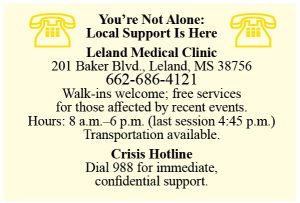
“Anyone who has been affected by the recent tragedy is welcome to come into the clinic or call,” Shaw said. “If we have a counselor available, you can see them right away; otherwise, we will schedule the next appointment slot or a time that works best for you. We are offering all counseling services of those affected by the recent Leland tragedy at no cost to the community.”
The clinic provides transportation, welcomes children during sessions, and uses a sliding-scale fee system for long-term care.
“We are in a family-friendly environment, so if a mother needs to bring her children in with her to her session, we are open to that,” Shaw said. “Our hours are from 8 a.m. to 6 p.m., and our last evening session of the day is 4:45 p.m. We do offer a virtual option, but if a client is at risk, we may not be able to see them virtually for safety and ethical reasons.”
 Fast-Track Trauma Response
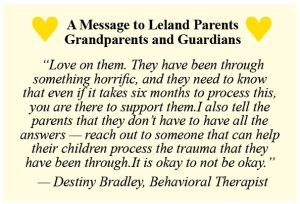
After a crisis, Shaw said the clinic focuses on “triage, stabilization and connection.”
“After a tragic or distressing event, many students will show acute stress reactions—panic, tearfulness, shutdown, irritability or physical complaints,” she explained. “The goal is to triage, stabilize and then connect. In our case, this means that we get them on a routine schedule of sessions to process what is happening and start some form of trauma therapy.”
Community-Wide Support
Hilary Meier, Vice President of Health at Leland Medical Clinic, said the clinic is coordinating care so trauma-informed practices extend beyond the counseling office and into the wider community, which can play a key role in stabilizing children and families right now.
“Be available to the community. If someone is coming to you for support, listen to them and help them seek the services they need, whether that is at Leland Medical Clinic or another mental health organization,” she said. “Usually when people ask for help, it’s because they are finally at the point where they can’t do it alone anymore.”
Looking Ahead: 60 Days of Healing
Leland Medical Clinic plans to continue offering free counseling for those affected by the tragedy while expanding EMDR therapy and small-group programs to reach more families. Over the next 60 days, clinic leaders will track one simple but meaningful measure — time to first contact — to ensure that every request for help receives a rapid response.
The goal, they said, is to make sure every resident who reaches out for care receives a response within days rather than weeks, so that healing can begin as soon as someone is ready. When people find calm, connection follows.