The things we stopped seeing — and what the ice revealed
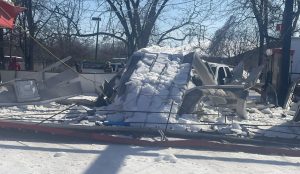
Photos special to The Leland Progress / Greenville Fire Department, Greenville Fire Department crews respond after a gas pump canopy collapsed at Rick’s Express on Broadway on Tuesday, Jan. 27, 2026, in Greenville. The structure fell onto several vehicles, and approximately 10 people were transported to area hospitals with injuries ranging from minor to serious. Officials said ice and water buildup from the winter storm likely contributed to the collapse.
by Lora Delhom
Rabies in dogs and measles in humans sound unrelated—until you realize they’re cousins, haunting us from the same cracked foundation. Different viruses. Same story.
The pattern goes like this: success → forgetting → vulnerability.
Rabies was pushed out of domestic dogs through mandatory vaccination laws. Measles was declared eliminated in the United States in 2000, following childhood immunization programs so effective they became almost invisible. When something disappears from daily life, collective memory fades. When memory fades, urgency follows. That’s when the cracks form.
What’s “coming back” isn’t the diseases themselves. It’s the exposure pathways.
In January, a rescue puppy transported from Florida to the Chicago area later tested positive for rabies, becoming the first confirmed rabid dog in Cook County since 1964. The case, reported by Block Club Chicago, triggered a multi-agency public health response, contact tracing, and post-exposure prophylaxis for anyone potentially exposed. Officials described the incident as a “perfect storm.” To the public, it read more like an ambush from the past.
Rabies never left. It moved into wildlife—bats, raccoons, skunks, foxes—where it has persisted quietly for decades. What changed was the interface. Interstate rescue pipelines, long incubation periods, incomplete immunity windows, and high trust in systems that usually work. Compassion built the bridge; biology crossed it.
Measles follows the same logic in a cleaner outfit. The virus was never eliminated globally. It simply waited. Uneven vaccination coverage, delayed schedules, dense social mixing—schools, planes, birthday parties. Measles doesn’t need many cracks. It needs one.
This isn’t a story about people “not believing in science.” It’s about systems that once felt solid now feeling abstract, distant, or vaguely threatening. Public health runs on boring, repetitive compliance. Culture rewards disruption, personalization, and vibes. Those instincts do not age well together.
In Mississippi, rabies in land animals is extraordinarily rare. Only two confirmed animal cases have been recorded since 1961—a feral cat in 2015 and a child who died after a bat exposure in 2005. Bats remain the most common carriers. The virus is present in the ecosystem; it just hides well when prevention is working.
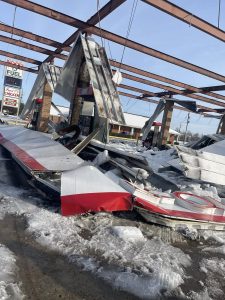
Minutes after clearing the scene at Rick’s Express, Greenville Fire Department crews responded to a second canopy collapse at the B-Quik on Reed Road, where one injury was reported and several vehicles were damaged.
Public health isn’t engineering—it’s gardening. It requires maintenance, repetition, and attention to edges. Stop tending it and weeds return. Fences sag. Old threats reappear looking theatrical because we forgot what they actually do.
Which brings me to my backyard, staring at a headless chicken and thinking: Was that a raccoon… or a fox? Because once you stop seeing danger clearly, everything feels both absurd and slightly fatal.
And yet, walking through an ice storm, the threat feels clearer than rabies or measles ever do.
Ice is immediate, legible risk. You hear it before you see it—the crack of branches, the glassy whisper under your boots. Your body knows how to read it. Every step becomes a calculation. You slow down. You adjust. Danger exists in the present tense.
Rabies and measles live in conditional time. They belong to systems, not sidewalks. Deferred risk. Statistical risk. You don’t feel them while crossing the yard. Ice announces itself. Ice doesn’t require belief.
That’s why the storm feels more alive. Not because biological threats are gone, but because they’ve become abstract—managed through layers of infrastructure that work best when no one notices them at all. Weather bypasses abstraction. It pushes back. It corrects you. It reminds you that physics still runs the room.
Public health asks us to respond to invisible gradients. Weather does not. Weather grabs you by the ankle and says: pay attention or fall.
In Greenville during the January winter storm, two gas station roofs collapsed under the weight of melting ice, injuring more than ten people. The structures didn’t fail because ice was unprecedented. They failed because they weren’t built—or maintained—to hold it.
This isn’t collapse. It’s exhaustion: the fatigue that comes from maintaining protections so effective they disappear, then being shocked when they’re needed again.
“Care is not a gesture; it is a practice.” — Joan Tronto
We didn’t summon these problems.
We just stopped tending the systems that kept them out.
Old diseases don’t die.
They wait.And the longer we forget how to see risk—in viruses, in infrastructure, in the quiet math of prevention—the more shocking it is when the weight finally comes down.