Where choice meets distance: Mississippi’s education bill heads to the Senate
By Lora Delhom
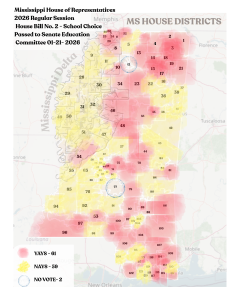
The Mississippi House passed House Bill 2 by a 61–59 vote. Many Delta and rural legislators voted against the bill.
Mississippi’s school-choice debate has returned in force this session. In mid-January, the Mississippi House of Representatives narrowly passed House Bill 2 — titled the Mississippi Educational Freedom Program Act of 2026 — by a 61–59 vote after hours of floor debate. The measure cleared the House Education Committee earlier in the session on a party-line vote (14–11) before advancing to the full House. It has now been transmitted to the Mississippi Senate Education Committee, where it awaits consideration.
From proposal to package
As recently as October, state leaders were still outlining broad concepts and competing ideas about how far Mississippi should go in reshaping K–12 education, following national attention on early literacy gains often referred to as the “Mississippi Miracle.” Since then, those ideas have hardened into bill text.
House Bill 2 represents House leadership’s most comprehensive education proposal of the 2026 session. Jason White, the bill’s chief proponent, has framed the legislation as an effort to ensure that “all Mississippi families, regardless of income or zip code, have real choices and the freedom to pursue what works best for their children.”
As passed by the House, HB 2 is a sweeping omnibus package that attempts to address multiple priorities at once: the creation of education savings accounts, changes to public-to-public transfer rules, revisions to charter school governance, expanded literacy and math intervention requirements, homeschool extracurricular access under the Tim Tebow Act, and a range of additional policy changes.
Magnolia Student Accounts
The bill’s most prominent new feature would establish Magnolia Student Accounts (MSAs), a state-supported education savings account program that allows families to direct public funds toward approved education expenses.
Participation would be capped and phased in gradually. Under the House version, the program would begin in the 2027–2028 academic year with up to 12,500 students statewide, increasing by 2,500 students annually for several years. Access would be prioritized by household income using area median income (AMI) tiers, with a lottery if demand exceeds available accounts.
How much families could receive varies by use. Students attending participating schools could receive up to the state’s base student cost, roughly $7,000 per student. Students attending non-participating schools would be capped at $2,000 (maximum $4,000 per household). Families using a “legitimate home instruction program” would be capped at $1,000 per family.
In a Jan. 7, 2026 explainer, Mississippi Today reported that House Education Chairman Rob Roberson said the accounts would likely average about $7,000 per student, putting the first-year cost at approximately $87.5 million for 12,500 students. By comparison, average private-school tuition in Mississippi is often cited in the $6,000–$11,000 range per child, while the FY 2025 public-school base student cost was $6,695.34.
Eligibility for the accounts is prioritized by AMI, calculated by geography using federal data from the U.S. Department of Housing and Urban Development. In Washington County, the FY 2025 HUD median family income is approximately $54,600 for a four-person household, placing the 300% AMI threshold at about $163,800. In the Jackson metro area, the comparable median family income is about $89,100, pushing the 300% threshold to roughly $267,000.
Because AMI is tied to local income levels, the same eligibility standard results in very different dollar thresholds in rural counties versus metro areas. Urban regions also tend to have more schools within commuting distance, which can shape how usable “choice” is in practice once transportation, tuition gaps, and time costs are considered.
The bill also creates an Education Freedom Fund within the State Treasury and assigns administration of the program to the State Treasurer’s Office, including oversight of approved expenses and fraud-prevention rules.
Supporters argue the structure expands options for families who feel limited by geography or district boundaries. Critics counter that even capped programs could divert funding and attention from public schools, particularly in small districts where modest enrollment changes can affect staffing and services.
Public-to-public transfers
House Bill 2 also revises Mississippi’s student portability laws. Under the bill, students could transfer to another public school district without consent from their home district, provided the receiving district agrees and has capacity.
Districts would be required to publish enrollment capacity, timelines, and policies, and the Mississippi Department of Education would collect and release annual data on transfers and denials.
In rural areas, this provision may have more immediate impact than private-school accounts. Many families are more likely to seek another public option — such as a neighboring district or magnet program — than to pursue a distant private school, particularly when transportation is not provided.
What begins sooner: literacy and math
Not all elements of House Bill 2 are delayed. Several provisions would take effect earlier, including expanded literacy and math initiatives.
The bill extends structured literacy interventions into grades 4–8 and requires districts to notify parents and provide individual reading plans for students identified with reading deficiencies.
It also establishes the Mississippi Math Act (M³), which would require districts to administer K–5 math screeners three times per year beginning in the 2026–2027 school year and to develop Individualized Math Plans for students below benchmark.
Even among lawmakers and educators who disagree sharply on voucher-style programs, these academic intervention measures are often cited as areas of broad agreement.
Why geography matters in the Delta
In metropolitan areas, school choice can mean crossing town. In the Delta, it can mean longer drives, higher fuel costs, childcare logistics, and missed work — challenges that compound for families already traveling for special education, health care, and specialized services.
That reality is reflected in the House vote map, which shows many Delta districts voting against House Bill 2. Local leaders in rural communities have emphasized the need for transition funding, transportation solutions, and transparent reporting so residents can understand how changes would affect enrollment, staffing, and services.
In small districts, even modest enrollment shifts can have outsized effects. When the local public school is the heart of a town, changes in funding or staffing can ripple outward — affecting extracurriculars, special services, and day-to-day support. In some communities, educators already step in informally to fill gaps, underscoring how closely resources and community capacity are tied to enrollment in rural schools.
What comes next
With House passage complete, House Bill 2 now moves to the Senate Education Committee for deliberation. Senate leadership has previously signaled stronger interest in teacher pay increases and public-to-public transfer flexibility than in large-scale private-school funding programs, increasing the likelihood that the House-passed bill could be amended, narrowed, or partially reworked in committee.
While House Bill 2 includes a modest increase for assistant teachers — raising the minimum salary from $17,000 to $20,000 beginning in the 2026–2027 school year — broader teacher pay raises are being considered separately through Senate-originated legislation that has already been transmitted to the House, underscoring differing priorities between the chambers.
For Delta parents, educators, and school leaders, the central question is not simply whether Mississippi expands “choice,” but whether any final package accounts for rural distance, small-district realities, services for students with disabilities, and accountability the public can easily understand.
The Senate posts standing committee meeting times (the default weekly schedule). For 2026:
-
-
- Wednesdays — 1:30 p.m. — Room 409 — Education
- Thursdays — 9:00 a.m. — Room 216 — Education
-
(A specific HB 2 hearing would show up on the Senate Committee Agenda once posted.)
Senate Committee Agenda:
https://www.legislature.ms.gov/calendars-and-schedules/senate-committee-agenda/
Senate Schedule (daily rooms/times):
https://www.legislature.ms.gov/calendars-and-schedules/senate-schedule/
Standing committee meeting list PDF (shows Education weekly times):
https://billstatus.ls.state.ms.us/2026/pdf/s_standing.pdf
HB 2 tracker (status + actions):
https://legiscan.com/MS/bill/HB2/2026
When the MS Senate meets
What’s in H.B. 2?
House Bill 2 — the Mississippi Educational Freedom Program Act of 2026 — is an omnibus package combining school-choice mechanisms with public-school policy changes and new academic intervention requirements. Below are the major provisions, organized for quick scanning. (All provisions reflect the House-passed version.)
1) Who runs the program?
-
-
- State treasurer as administrator (Section 4): HB 2 places the Education Freedom Program under the Office of the State Treasurer, referred to in the bill as the “fund manager.”
- The fund manager may contract with certified educational assistance organizations to help administer the program.
-
2) Magnolia student accounts (MSAs): the new “choice” program
Start date and caps (Sections 5–6)
-
-
- Begins 2027–2028.
- Caps participation at 12,500 students in year one, increasing by 2,500 students per year for four years. Future growth tied to demand.
-
Who gets priority
-
-
- Half of MSAs reserved for students who attended public school the prior year.
- Half available regardless of prior public-school attendance.
- Eligibility is broad, but priority is income-based using area median income (AMI) tiers:
- up to 100% AMI (first priority)
- 100%–200% AMI (second)
- 200%–300% AMI (third)
- If demand exceeds supply, awards are made by lottery, with siblings given priority.
-
Where MSAs can be used
-
-
- At participating schools approved by the fund manager, including:
- accredited non-public Mississippi schools operating at least four years
- Mississippi postsecondary institutions
- public schools outside a student’s home district
- At some non-participating schools
- For “legitimate home instruction programs” (as defined in the bill and future rules)
- At participating schools approved by the fund manager, including:
-
How much families could receive
-
-
- Participating schools: up to the base student cost under Mississippi’s funding formula (about $7,000 per student).
- Non-participating schools (not homeschooling): up to $2,000 (maximum $4,000 per household).
- Home instruction programs: up to $1,000 (maximum $1,000 per family).
-
Allowed and prohibited expenses
-
-
- Allowed: tuition, fees, testing, uniforms, approved supplies, curriculum, technology, services, and transportation to/from an approved provider.
- Not allowed: televisions, video game systems, home theater or audio equipment, and virtual reality products.
-
3) Special-needs scholarships: separate track
-
-
- Section 7 states the Equal Opportunity Scholarship for Students with Special Needs remains separate from MSAs and portability scholarships.
- Students may participate in only one of these programs at a time.
-
4) Testing and reporting for MSA participants
-
-
- Sections 8–10 require participating students to complete one assessment chosen by the parent:
- a test aligned to the participating school’s curriculum, or
- a nationally norm-referenced achievement test, or
- a nationally recognized aptitude assessment.
- Students with disabilities are exempt from the assessment requirement in the House version.
- Participating students would not take Mississippi’s state standardized tests.
- The fund manager must publish an annual statewide performance summary.
- Sections 8–10 require participating students to complete one assessment chosen by the parent:
-
5) Education service providers: approvals and rules
-
-
- Section 9 establishes approval requirements for education service providers, including schools, organizations, certified assistance groups, and certain individuals (not parents).
- Providers must meet standards related to reporting, nondiscrimination, and child protections.
- The fund manager may suspend or revoke approval.
-
6) Education freedom fund: how the bill is funded
-
-
- Section 12 creates the Education Freedom Fund to pay for MSAs, portability scholarships, and ESAs.
- Funding sources include legislative appropriations, capped formulas, federal funds, grants, and donations.
- The bill sets rules for how funds carry over year to year.
-
7) Public-school transfers and portability scholarships
-
-
- Section 13 removes the home district consent requirement for public-to-public transfers, while still requiring receiving district consent.
- Districts must publish enrollment timelines, capacity limits, and nondiscrimination policies.
- The Mississippi Department of Education would publish annual transfer and capacity data.
- Creates a student portability scholarship districts may apply for (parents do not control it), capped at the lesser of:
- transfer tuition
- the local funding portion that does not follow the student
- $2,000
- Districts receiving the scholarship may not charge additional tuition or fees.
-
8) Tim Tebow Act: homeschool extracurricular access
-
-
- Section 14 allows students in a legitimate home instruction program to participate in public-school extracurricular activities at their assigned school.
-
9) Literacy and math requirements (earlier implementation)
Adolescent literacy initiative (Sections 15–25)
-
-
- Expands literacy supports for grades 5–8, including teacher training aligned to the science of reading, approved assessments, interventions, and parent notification.
-
Mississippi math act / M³ (Sections 26–38)
-
-
- Requires K–5 math screeners three times per year beginning 2026–2027.
- Establishes math coaching and Individualized Math Plans for students below benchmark.
- Adds an Algebra Readiness Indicator tied to Grade 5 math assessment results.
-
10) Charter changes, pay, dashboards, and other provisions
HB 2 also includes:
-
-
- charter governance and authorization changes
- assistant teacher minimum salary increase to $20,000 beginning 2026–2027
- increased dyslexia therapy and speech-language impairment scholarships
- a school accountability dashboard requirement
- retired teacher employment provisions
- a dual-enrollment/early-college high school model with a boarding option (AGENTS of Excellence Act)
- a directive to seek a federal waiver related to assessments
- a $10 million JROTC pilot program
- consolidation of Copiah County and Hazlehurst City school districts
- a local-option policy for prayer or reflection at the start of the school day
- additional technical and eligibility changes
-
Effective date
- The act takes effect July 1, 2026 (Section 171), though many provisions phase in later.
Editor’s note: HB 2 is a large, fast-moving bill. The Senate may amend or replace major sections. This summary reflects the House-passed version at the time of publication.